


 The tension setting may be simple, but it’s sure to turn heads. This unique engagement ring style seems to suspend a gemstone in midair, making it a striking modern pick for popping the question.
Although a tension setting may seem like a risky way to hold a precious gem, it’s not nearly as precarious as it seems. In spite of its name, this style uses not tension but compression to keep a diamond or other gem in place. The stone actually sits in tiny groves that are carved into the band, while that band squeezes it securely in place on either side. Thus, the tension setting is actually quite secure, and in some cases it’s even more secure than a more traditional prong setting.
The tension setting is about 50 years old, having been invented in the 1960s by Friedrich Becker at Niessing, a German jewelry company. While it took approximately two decades before this design started to show up in jewelry, once it did, it gained many fans in short order.
Many people are draw to the tension setting not only for its ability to create the illusion of a floating gemstone, but also due to the fact that it’s flattering to gemstones. Since the tension setting leaves a stone open on the bottom, it allows more light to pass through that stone than a traditional prong setting, creating a greater sense of brilliance.
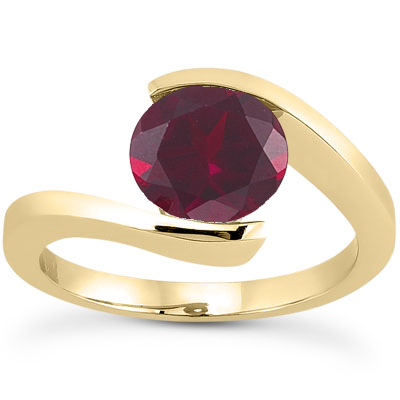 While the original tension ring held a diamond in fairly straightforward fashion in a simple, traditionally-shaped band, this look is far from your only option if you’re searching for a unique style that seems to make a diamond float. For instance, many variations on the tension ring have curving bands that squeeze the stone on the top and bottom, creating truly eye-catching styles. For instance, pieces like the 0.75 Carat Tension Set Diamond Engagement Ring seem to hug the center stone like a tender embrace.
A tension setting is also a unique and striking option for gemstone engagement rings; however, not all stones are good candidates for this style. Since it places a great deal of pressure on a stone, only gems that are quite hard are suited for the tension setting. Good candidates include sapphire (both the traditional blue variety and the less expected pink and white varieties), ruby and moissanite. Regardless of which stone you choose, the tension setting brings out the best in a gem, and does it with a sense of mystery.